Book with complete peace of mind thanks to our flexible cancellation policy. Learn more
vive Peñíscola

Our Tours

Contact us

Author: David

Inicio / Archivo de David

On our coast, it is still possible to spot watchtowers or defense towers; some are well-preserved, others abandoned and in ruins, while others have disappeared over the centuries.

These towers were built during the 16th and 17th centuries with the mission of monitoring and protecting the inhabitants of coastal towns from attacks by Barbary pirates. The entire coast could communicate from tower to tower and, in turn, with the castles, in order to sound the alarm about their dangerous presence.

But who were they?

Barbary pirates and privateers, with their galleys powered by the oars of abducted slaves, disrupted maritime traffic coming from the area now equivalent to the Maghreb and, from their bases, sowed terror and turned the Mediterranean into a literal hell. Although piracy was by no means a new phenomenon, it was exacerbated during the conflict between Christianity and Islam, which culminated in the conquest of Granada and the fall of Constantinople.

Another key event was the expulsion of the Moorish population ordered in 1609, which led to the forced expulsion and loss of almost one third of the population of the Kingdom of Valencia… That human tragedy undoubtedly fueled piracy.

Silent witnesses to this are the enormous depopulated areas on the Spanish and Italian Mediterranean coast, which remained so until well into the 20th century, as happened in our province. It is estimated that between the 16th and 19th centuries, more than one and a half million people could have been captured to be sold in the slave market. Some of these raids have endured in the collective memory due to their dramatic impact on coastal towns, and that is where the expression “Moors on the coast” comes from, and they are even at the origin of the names of towns like Torreblanca.

In response to these incursions, we find towers of various types in our province, whether in castles and fortifications, rural towers, beach towers, or watchtowers located on high ground or cliffs.

Among the watchtowers, we highlight the spectacular Torre Badum in the Serra d’Irta or the Torre Ebrí, at 499 meters above sea level. On the Oropesa Greenway, we find two towers like the Cordà and the Colomera, built to support the Torre del Rey. Regarding beach towers, we highlight the Torre del Mar in Borriana, the Sant Vicent in Benicàssim, Torre la Sal, and Torre Nostra or Capicorp in Alcossebre. And there are many others that have disappeared and have been definitively swallowed by time.

This summer we propose a unique experience that will recover, from the sea, the memory forgotten for centuries on our coasts, including piracy…

It is called “Sea Twilights, stories and wine.”

Embark to rediscover our history through the ancestral connection between our wines and the sea, including a tasting of 3 select wines with history from the Maestrat.

All information and bookings at www.exploramaestrat.com
Places can be enjoyed in many ways but the best of all is to explore them with all your senses.

El Maestrat is a historic region where you’ll find villages full of stories, castles, walls, churches, legends… But also landscapes of great diversity and, with them, flavours with a strong personality.

Rugged terraced landscapes, shaped by the sweat of those who have lived here and by the civilisations that have left their mark.

The greatest expression of this cultural mix is the spectacular landscapes of ancient olive trees. Yes, in this region, and alongside the Roman Via Augusta, you’ll find the largest concentration of monumental olive trees on the planet. Living beings of exceptional value, not only for their beauty and size, but because they connect us with our deepest roots.

How many generations of ancestors have been fed, lit, healed, cleaned by the olive oil produced by that very olive tree you’re looking at now? How many wars, droughts, plagues, fires, frosts or fashions has it survived?

The result of this impressive human-shaped landscape is the elixir of eternity, also known as ancient olive oil, from the very old Farga variety.

Olive oil is the foundation of the world-renowned Mediterranean diet and of our most genuine culture.

And it is precisely from La Jana, in the heart of El Maestrat, that we begin our journey that will take us to the Mediterranean.

With the blue sea in sight, we find other gastronomic treasures, such as the citrus groves in Vinaròs. It was right here, in 1948, that the most prized orange variety in the world emerged: the exquisite Navelate. A surprising story that deserves to be told.

Did you know that every orange that reaches your table is a fascinating history lesson? Because the Fruit of the Gods has a great story to tell—and to delight us with.

Near the sea we’ll also find fertile market gardens, presided over by the Artichoke of

Benicarló, the only Designation of Origin in Castellón. The Queen of Benicarló’s market gardens lives in an agricultural landscape rich in hermitages, barrel-vaulted cottages with pergolas, waterwheels and cisterns.

A true Mediterranean experience is to harvest them with a basket and taste the sweet bitterness of our “green rose” in the fields.

On our gastronomic journey we couldn’t forget the sea and its bounty.

In fact, we know more about the surface of the Moon than the bottom of our sea… A host of secrets awaits us if we decide to enjoy an unforgettable seafaring experience from our ports and fish markets!

In El Maestrat, fishing diversity is especially remarkable thanks to its proximity to the Ebro Delta… That’s why the star product is the Vinaròs prawn. And this is an incomparable draw to immerse ourselves in a wonderful experience: the fish market, fishing techniques, ancestral seafaring knowledge and flavours…

For all these reasons and many more, we invite you to explore El Maestrat, an incomparable gastronomic pantry.

From oblivion to superfood: a delicious story

With the arrival of autumn, the imposing carob trees reveal the dark pods hanging from their green branches. Although Spain is the world’s leading producer of carob, the Valencian Community is the top producing region and Baix Maestrat the epicentre of its production, for many it remains largely unknown, and in recent decades the crop has suffered a serious decline and abandonment—until everything changed.

The carob tree (Ceratonia siliqua) had, until fairly recently, been valued for its versatility and hardiness, as it grows in any soil near the coast and withstands drought well, adapting to land that would otherwise be bare or unproductive.

The word that names the genus, Ceratonia, comes from the Greek Keras (horn), as the appearance, shape and consistency of the fruit resemble a horn.

Carob is a legume that has been used by humans for centuries, and its cultivation spread throughout the Mediterranean basin. From Egypt it passed to Greece and from there to Italy. The Phoenicians and Arabs spread it along the North African coast, from where it reached Spain—a country that has used its seeds to make livestock flour and its pods to produce spirits, syrups and medicinal poultices.

But if there is one feature that makes the carob tree unique in the plant kingdom, it is the uniformity of its seeds: because they all weigh very similarly, close to 0.2 grams, they were used as the first unit or standard for measuring the weight of gems and precious stones, and the Arabs called it Qirat, which passed into Spanish as quilate (carat).

More recently, during the Spanish Civil War, it was widely used to fight hunger and malnutrition due to its high energy value, which is why it was stigmatised as “poor people’s food”.

Its toasted, fruity flavour—slightly bitter and sweet at the same time—resembles chocolate so much that in the post-war years it was very popular with children, as there were no resources to buy imported cocoa.

However, few people know that it is an excellent natural food that recent research has reappraised for its incredible properties—specifically for providing the fabulous compound D-pinitol, with anticancer, antidiabetic, antioxidant and slimming effects, among other applications.

Truly a tree that’s worth its weight in gold.

Discover the many culinary uses of carob and the millennia-old culture of its cultivation in El Maestrat in the unique themed experience Ruta de la algarroba this October
All information and bookings here: www.exploramaestrat.com

It’s the 60th anniversary of the filming of the lavish blockbuster that changed the history of Peñíscola.
The slogan announced it would be “the most beautiful film in cinema history.”

There was a time when, by the grace of Hollywood, everything in Peñíscola changed.

Between December 1960 and February 1961—exactly 60 years ago—El Cid was filmed, directed by Anthony Mann (who was married to Sara Montiel at the time), produced by Samuel Bronston, and starring Charlton Heston and Sophia Loren.

In a matter of weeks, starting in November 1960, a mighty fortress—half real and half papier-mâché—emerged through the power of technology and the dollar. Locals themselves began to doubt whether it was solid rock or papier-mâché, and the press, caught up in the effervescent atmosphere, dubbed it a “modern Babel.”

The set was so grand that it earned a place in the Guinness Book of Records.
The filming was equally impressive, involving over 5,000 people, including around 2,000 soldiers brought in from as far away as Madrid, along with more than a hundred horses from the Mounted Police.
In Peñíscola, everyone worked on the film—men and women, young and old. Entire families took part, including grandparents, parents, and grandchildren, and in some cases, they even rented out their homes for lodging, their boats, or even their animals for the shoot.

The pay was well worth it; 100 pesetas a day was an extraordinarily generous amount in the black-and-white Spain of the early ’60s, a country accustomed to the meager returns of subsistence farming and fishing.

It was celluloid that would once again bring global fame to the Fortress City, which had already been in the world’s spotlight centuries earlier with the unshakable Pope Luna. El Cid would rediscover the unparalleled charm of the City in the Sea for the world.
Following the international notoriety it gained, Peñíscola reversed its historical trend, shifting from a constant source of emigrants to a magnet for new residents. The hotel industry began to take off, and our city started to be known as the “European Hollywood.”

No one forgot the filming in that Peñíscola. Not even him, Charlton Heston, El Cid.
One of the most charismatic actors in cinema history confessed decades later that El Cid was one of his favorite characters. In 1991, he fulfilled his wish by returning to the locations where his epic story was forged.

Today, 60 years later, Rodrigo Díaz de Vivar—El Cid—continues to fascinate us… and at the same time, stir up controversy. Proof of this is the recent release of a successful series based on his character. But who was El Cid, really?

To solve this and other mysteries, we’ve created a themed guided tour of the filming locations titled El Cid: Myth, History, and Cinema. A tour that won’t leave anyone indifferent.

A unique and spectacular landscape awaits us in the Maestrat. The ancient olive trees fascinate us with their eternal beauty and their liquid gold.

The olive tree is an emblematic tree of the Mediterranean and the quintessential symbol of eternity.

It holds a privileged place in both Roman and Greek mythology, among others, where it was declared ‘the most useful of all trees’. Its uniqueness is appreciated in sacred texts as relevant as the Bible or the Quran.

Present in its wild form for over 14,000 years, olive cultivation only began a little over 6,000 years ago. In the Iberian Peninsula, they were introduced by Phoenician navigators, and their expansion and cultivation were continued by Greeks, Carthaginians, Romans, and Muslims.

Throughout the Mediterranean basin, we find isolated specimens of spectacular longevity, whether in Crete, Turkey, Tunisia, Malta, Sardinia… Are they the oldest olive trees in the world?

It is certainly difficult to calculate the age of an olive tree.

What we can affirm without a doubt is that they are authentic living monuments, wooden cathedrals, legacies of a culture and of extraordinary value.

In the Maestrat, we hold a curious world record: hosting the largest number of ancient olive tree specimens in the Sénia territory, often combined with spectacular dry-stone architectures.

An extraordinary landscape.

Its fruit has had countless uses throughout history, hence the survival of its cultivation for so many generations and despite so many vicissitudes that occur over the millennia.

Olive oil has been present in our lives for thousands of years. It is the basis of the world-renowned Mediterranean diet. A product of high culinary value that has become a lifestyle, something cultural.
Ancient olive trees, due to their age, are much less productive, but in return, they produce highly prized gourmet extra virgin oils among the most discerning palates.

The ancient olive tree variety par excellence in the Maestrat is Farga, the longest-lived and most resistant. Their twisted trunks can reach over 10 meters in perimeter in exceptional cases.
They are authentic miracles of life, elixirs of eternity.

Therefore, an unbeatable way to enjoy spring in Castellón is to experience these impressive landscapes and explore the ancient olive tree culture, the essence of the Mediterranean.

“A place where the rugged drylands, carob trees, olive trees, abandoned fields, and wind-swept pines reach all the way to the sea” (J. M. Almerich)

In these days of pandemic, confinement, and necessary reinvention, the need has come to the forefront to finally apply in concrete terms concepts that until now were merely theoretical, such as sustainability, destination carrying capacity, and beach capacity limits. In short, a return to the past…

Can you imagine what that Mediterranean was like just a few decades ago?

We invite you to a place that exudes the smell of salt, painted in ochre and green tones, but above all blue, and where the sea breeze cradles us with the hollow sway of the waves.

In the far north, between Peñíscola and Alcossebre, in the historic and diverse region of Maestrat, we find a coastal paradise that, especially in this context, emerges as any traveler’s dream: The Serra d’Irta.

Irta is a natural and cultural jewel, and its conservation, a true miracle despite the advance of urbanization.

A Natural Park, marine reserve included, where the clock stopped long ago, a refuge of splendid panoramas, where mountain and sea merge in an embrace, as it jealously preserves about 13 km of virgin coastline, with a succession of coves with crystal-clear waters.

An unusual occurrence in today’s overcrowded Spanish Mediterranean, constituting a unique space between the French border and all the way to Cabo de Gata.

In this vast natural oasis near the unmistakable bastion of Peñíscola, along delightful trails, we can explore two Islamic castles (Xivert and Polpís), hermitages, abandoned Moorish settlements, Iberian villages, and several watchtowers (Badum, Ebrí, Torre Nova) that evoke the proverbial sentinel function of this strategic coastal mountain range.

Irta was essential for the survival of our ancestors… it served as winter grazing land for transhumant livestock, a supply area for firewood and collection of “multi-use” plants, such as dwarf fan palm (chamaerops humilis), a place for charcoal-making and lime production, a coastal shore exploited by fishermen, and an area of sustainable cultivation following the spectacular terracing and clearing of its uneven and inhospitable lands.

Until a few decades ago, these arid dry-stone terraces were home to carob trees, vineyards, and olive trees, and today they offer silent testimony, facing the solitude of the blue Mediterranean, to the centuries-old struggle for survival.

One of the most fascinating aspects of our Sierra is its geological richness,

especially surprising along the coastline itself, formed by beautiful coves and cliffs, where we find various “ullals”, underground freshwater springs (which some studies estimate at a staggering 500 hm3 annually) that emerge to immediately merge with the sea waves, and which gave rise to evocative legends. Can you imagine finding fresh water in the sand itself?

In short, a place in the world to lose yourself and to find yourself.

For many reasons it is worth exploring the last Virgin Sierra of the Spanish Mediterranean.

And with it, to reconnect with the most authentic and wild Mediterranean, the one that today, more than ever, we must all protect like the crown jewels.

We invite you to enjoy the sunset in this paradise every Thursday at 7:00 PM on a route that combines sea and mountain with breathtaking landscapes.

To speak of wine is to speak of humanity itself, of our essence and our culture.

September is the most important and magical month for wine…After the summer heat, the grapes are ready for harvest. The time when vineyards are teeming with life, and when the magical ritual of each year begins. Because, although the wine-making process is key, the artisanal grape harvest is no less so.

This time offers us the perfect opportunity to explore and discover the ancient tradition upon which the roots of our Mediterranean culture are based, and to practice one of the most enriching and impactful experiences the region offers: wine tourism.

Due to its uniqueness and tradition, the grape harvest is a task full of curiosities. A task that, even today, largely preserves the practices of Egyptians, Greeks, Romans, and Phoenicians. Peoples for whom wine was an essential part of their lives.

Much of the grape harvest as we know it, we owe to the Egyptians. This is because these people harvested grapes in a way that was practically the same as today. And not only that: both the treading of the grapes, which was done by the harvesters themselves, and the celebrations at the end of the harvest also date from that time.

In Ancient Rome, one of the peoples responsible for the spread of vine cultivation throughout Europe, this task of harvesting grapes was marked by two very unique guidelines. Firstly, only women could perform it. Secondly, the grape harvest followed its own pattern: only grapes exposed to the sun were collected, discarding the rest.

A starting point that usually led to a true bacchanal which, of course, honored another of the mythological gods of wine: Bacchus.

Our historic Maestrat region, crossed by the Roman Via Augusta, was known for wine production since Roman times and reached great heights of fame for its wines at the end of the 19th century.

There are still small traditional wineries in the heart of Maestrat that preserve this ancient art and invite us to enjoy the experience, such as Celler l’Estanquer in Canet lo Roig. Hand in hand with Turisme Vinaròs and with an experience designed by the ecotourism company Explora Maestrat, we offer the opportunity to live this unforgettable experience, at the most beautiful time of the year: from the vineyard, the grape harvest, to the treading of the grapes and the making of wines… including the tasting of musts and wines.

Saturday, September 4, experience the Dawn Grape Harvest: Sips of History in Maestrat.

Small groups.

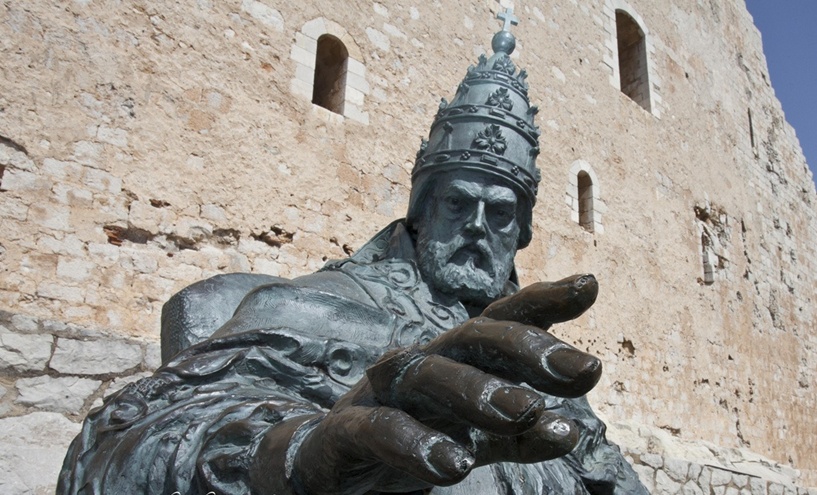
Visiting Peñíscola is synonymous with visiting the City of Pope Luna, the most controversial and charismatic Pope in History.

We propose a journey back in time, to the days when a terrible pandemic, the Black Death, killed one in three Europeans. Benedict XIII is a product of this turbulent era… Times when the Holy See moved from Rome to Avignon in a fierce struggle with France for the political influence of the Papacy.

Born in 1328 in Ilueca, Zaragoza, into one of Aragon’s great lineages, the Luna family, Pedro Martínez de Luna y Pérez de Gotor soon directed his life towards religious pursuits, becoming a cardinal in 1375,

that is, three years before the great scandal that would dramatically shake the history of the Church, and which we would come to know as the Great Western Schism.

With the Pope’s return to Rome, the subsequent return of the Holy See, and his death, the time came to elect a new pope through a conclave. Pressure from the Romans ensured that the resulting “white smoke” from the conclave favored a pope of their choosing and liking. An election that was flawed, according to the cardinals, which led to it being declared invalid and the decision to appoint a new pope who would be established in Avignon.

The Church had two popes at the same time, thus beginning a dramatic schism that would divide the Church for about 40 years. Both sees rushed to seek support, dividing Europe according to their partisans.

Upon the death of the Pope of Avignon, Pedro de Luna was elected the new Pontiff, taking the name Benedict XIII.

And precisely in what happened from this moment, lies the origin of the expression “to stick to one’s guns” (literally, ‘to stay in one’s thirteen’).

Benedict XIII never yielded to the intense pressures he suffered, nor did he submit to anyone’s political will, considering himself the only legitimate Pope until his death.

To continue his papal work, he was forced to leave Avignon when the French monarchy lost interest in keeping the Papacy on French soil.

Thus, he sought refuge in the Crown of Aragon, where he was still considered the only legitimate pope, and arrived in Peñíscola, where the Knights Templar had built a formidable fortress a century earlier.

Due to his stubbornness, he was excommunicated, persecuted, and they tried to assassinate him, but they did not succeed. A life of resistance that reached epic proportions, from the walls of Peñíscola Castle, and after the abandonment of his closest collaborator and personal confessor, Saint Vincent Ferrer.

But he stood his ground. The reason for that proverbial resistance?

He was the only pontiff elected pope by cardinals prior to the Western Schism, and for this reason, he maintained his challenge to the popes who emerged from the “rotten branch”, or those subjected to political influences, of Rome.

He would be buried in Peñíscola in 1423, convinced of being the only legitimate pope.

The legend of the Unthronable had only just begun.

Every weekend we have guided tours to rediscover the settings, characters, and fascinating history of Templar & Papal Peñíscola.

On the upcoming afternoons of December 4, 6, and 8, in the context of the Chocolate and Traditional Sweets Fair dedicated to Lluis Santapau held at Plaça Parroquial, themed experiential guided tours will be conducted about the historic connection between Vinaròs and chocolate.

The title of these tours is “Vinaròs and Chocolate: A Delicious History” and registration is now open on the calendar at www.turisme.vinaros.es and at the Tourist Office, until available spots are filled. After last year’s great reception, this edition will be recovered once again following all safety regulations.

The initiative of the Department of City Promotion and Tourist Interest, carried out by Explora Maestrat, recovered the sweetest memory of Vinaròs, a chocolate-making history of nearly 200 years.

The guided itinerary will tour the settings of the numerous chocolate factories and old points of sale that were located in the downtown area, from the pioneering Gombau factory, which opened in 1785, becoming one of the first in Europe, to the last to close, the legendary Serret factory, passing through others less well-known such as Adell, Martorell, Franco, Facund Fora…etc.

A time that evokes the historic commercial tradition of Vinaròs, an industry that was nourished by cocoa from American plantations and that reached its peak in the first third of the 20th century, when the workers’ society “La Unión” was even created to defend the interests of the thriving chocolate-making guild of Vinaròs.

Another of the settings is Carrer Sant Jaume, where Lluis Santapau i Egea (1906-1993) was born, an illustrious native of Vinaròs and pioneer in introducing the technique of chocolate figures applied to Easter monas. Confiteria Bover is also mentioned, run by Santapau’s sister and where the young pastry chef learned the technique before moving to Barcelona, where he would develop much of his career.

Santapau knew how to elevate pastry-making to an artistic level never seen before, revolutionizing the sector and obtaining numerous awards and recognitions.

The experience will end with a tasting of chocolates of various types and historical periods, as well as with gratitude to all those chocolate-making neighbors who have made the experience possible by sharing their experience, to Lluis Santapau, to the Fundació Caixa Vinaròs, etc.

An unmissable event not only for chocolate lovers but also for those interested in the history of our town…Without a doubt, a Delicious History.

A different, delicious, and unforgettable gastro-tourism experience

After the excesses of the holiday season comes January, the month of the dietary artichoke par excellence, especially in Benicarló, which holds the only Protected Designation of Origin in our province.

Also called by the Arabs al-khursuf or “little tongues of earth,” it is an edible flower with countless health properties and an essential element of our world-renowned “Mediterranean Diet,” Intangible Heritage of Humanity.

Through a gastro-tourism experience, we invite visitors to “peel back” all the layers of the Queen of Benicarló’s vegetable garden and embark on an evocative sensory journey through time to its origins: the Benicarló PGI Artichoke Tour. Will you join us?

Our imaginary journey begins in ancient Greece, where an old legend tells of a beautiful maiden named Cynara, with whom Zeus fell madly in love. The god decided to turn her into a goddess and take her with him to Olympus. But it was Cynara’s nostalgia that led her to escape from Olympus and return to her homeland, being punished in turn by Zeus to remain there eternally, transforming her into the first artichoke. Hence it retains its scientific name “Cynara Scolimus.”

We don’t know if the beautiful Cynara was violet or green, large or small, elongated or flattened, or which of the 20,000 existing species she would correspond to. But in Maestrat we prefer to imagine her as green in color, small in size and very compact and tight, with her characteristic dimple, of the variety known as “Blanca de Tudela,” and with a tender heart bursting with flavor.

Our journey has its next stop precisely in the sacred land where the farmer’s care and the sweetness of the unique climate by the sea allow its harmonious development. With the invaluable collaboration of a “garden alchemist” (also called a farmer), we will explore the stages of planting, formation, and countless curiosities about the artichoke…And we will pause at the harvest, identifying and selecting the best specimens from the particular “garden of green roses,” those that are ready to embark on the final journey to the most demanding palates.

Reaching the practical part of the experience, participants can feel like harvesters for a day with basket in hand, taking part in the harvest. But it will be at the countryside table where we will appreciate all the qualities and versatility of this vegetable by tasting an original themed appetizer: a spectacular artichoke skewer, paired with artisan artichoke beer.

“Before all other flowers, you arrive to reign over them all. And truly, you are a blessed omen, for in your candid beauty appears the first smile of the world and of spring.”

The Arab poet Ebn Teinim thus sang to the almond blossom.

It is one of the first cultivated foods in the world, as well as one of the trees whose flowers bloom earliest. For this reason, the word “almond” in Hebrew literally means “the awakened one”.

Indeed, its early flowering makes it the quintessential herald of spring, which also signifies nature’s annual rebirth.

The almond tree, originally from Central Asia, arrived on the Iberian Peninsula with the Phoenicians and spread with the Romans. As it spread, the beauty of its flower and the extraordinary usefulness of its fruit captivated all civilizations that knew it, inspiring beautiful legends.

In the Maestrat, ideal conditions exist for almond cultivation, so that in February, the once harsh lands and terraces transform into beautiful gardens of delicate white and pink flowers.

And among the infinite existing varieties, one native stands out, the ‘queen’ of our lands and the best almond variety in the world: the Marcona, with unanimous global recognition, known as the “golden nugget”. It has been used in medicine, in cosmetics, its shell as an energy source, and, of course, in our gastronomy.

And it has become the great protagonist of our traditional confectionery: nougats, marzipans, sweets, and cakes have benefited from its flavor and delicacy, to which new recipes and gastronomic applications have been added, such as ice creams, liqueurs, vegetable milk, sauces, etc.

The almond blossom is an extraordinary natural spectacle that deserves to be fully enjoyed.

For this reason, we have organized a genuine experience to discover the best flowering landscapes, the legends linked to it, curiosities, varieties, cultivation by an expert farmer, and of course, we will end the experience in the field by tasting delicious products made with the

“Crown Jewel” of our gastronomy.

Official presentation of the Artichoke Tour, a new gastro-tourism experience that combines gastronomy, culture, history, heritage, and nature.

In today’s press conference, we unveiled this initiative organized by the Benicarló Artichoke Regulatory Council. It will take place during the Benicarló Artichoke Festival on the weekend of January 26 and 27, 2019, as well as during the Gastronomic Days dedicated to the Benicarló artichoke—the only Protected Designation of Origin in the province of Castellón.

Yesterday, accompanied by a great group from Valencia, we had the chance to visit the best-kept secret of the Parish Church of Sant Bertomeu in Benicarló… its crypt.

It is a small, vaulted chamber carved into the rock, where it is estimated there were a total of 202 burials, all dating from before 1787. A truly interesting story.

It currently features a lifting hatch that provides access to 20 steps, which in turn lead down to the niches.

The 275 years of history behind the construction of the Church of Sant Bertomeu are, without a doubt, a great reason to visit this Baroque gem.

Our sincerest thanks to Father Carles for being such a wonderful host!!

Peñíscola, the City on the Sea, proudly claims to be the largest film set in the world.

It’s no wonder it has been chosen by so many films and series throughout the last century, becoming a star of the silver screen in its own right.

The connection between Peñíscola and cinema began over a century ago, in 1913 to be precise, with the filming of a spy adventure titled “Ana Cadova“. After that came several productions of various kinds, among which the endearing “Calabuch”, by Valencian master Luis García Berlanga, in 1956, stands out. But it wasn’t until five years later, in 1961, that the City on the Sea would definitively establish itself as one of the most prominent locations on the international scene. Hollywood, with all its pomp and splendor, would land on Peñíscola’s beach for three months, transforming the city into 11th-century Valencia, heroically taken by the legendary Castilian knight “El Cid”, played by Charlton Heston.

Recently, many series have found their setting in Peñíscola, such as El Barco, El Chiringuito de Pepe or even, at an international level, the most watched and awarded series of all time, Game of Thrones.

The American television series, based on the novel A Song of Ice and Fire, deserves a chapter of its own, having broken all existing records and continuing to stir passions wherever it goes. In Peñíscola, the filming brought together hundreds of extras and onlookers during the first week of October 2015, becoming a true event.

Five locations in Peñíscola were chosen, which would play the role of the free city of Meereen in the series. Beautiful locations that, it must be said, hardly needed any modification given the authenticity and excellent condition of the Fortress, and which therefore remain perfect settings to trace and recreate the steps of Tyrion Lannister and Lord Varys.

The growing demand from visitors interested in discovering and reliving these locations has led us to design a completely innovative and groundbreaking route that aspires to become an unmissable experience for every Game of Thrones fan.

A true #vivepeniscola experience.

In fact, the response from the first experiences is widely exceeding the best expectations.

Going beyond the old concept of a guided tour and aiming to offer a total experience, we take a complete journey through the five spectacular filming locations, supported by high-resolution images. With them, we can relive the protagonists’ dialogues and enable audience interaction, making them feel like protagonists themselves.

After passing through Plaza de Santa María, Portal Fosc, Rampa de Felipe II, Paso de Ronda along the walls…we arrive at the oasis of the Parque de Artillería, a harmonious site, formerly used as a defensive powder magazine and now transformed into a Garden, where some of the most beautiful scenes of Meereen were filmed.

And what better place, facing the immense blue of the Mediterranean, to end our Themed Route…but not before treating our guests to a unique and unforgettable moment: an exclusive private mini-concert for piano and cello duo with the most famous pieces from the series, such as Ours is the Fury, Blood of my Blood or The North Remembers.

A truly moving and unforgettable moment!

Our route continues to a select gourmet shop featuring local products, which has prepared with great dedication a themed menu that is absolutely original to Game of Thrones…A series of delicious dishes faithfully based on George R. Martin’s novel will parade before our eyes and be lovingly detailed.

This will be the crowning touch to an experience designed for fans of the series filmed in Peñíscola, which will surely remain in their memories as an unforgettable keepsake.

When is the next date?

Very soon Peñíscola will be Meereen again and we will once more feel the magic of Game of Thrones.

A few centuries later, we still feel that same simultaneously dense and free atmosphere, that indescribable sense of gravitas every time we ascend to one of the many viewpoints to contemplate the Mare Nostrum bathed in white moonlight.

That silver path across the watery plain still invites us to walk, to run, to search, to touch the Moon, which invariably seems closer than ever, within our reach.

We take advantage of these wonderful, dream-filled nights to rediscover the unforgettable legends that have illuminated the nights of Mediterranean peoples since the dawn of civilization. Whether it’s true or not, whether it really happened or not, the fact is that they have left an indelible mark on our memories.

I believe you’ll agree with me that there are certain moments when we understand that they are just dreams, but dreams are life.

Need a recommendation? Contact us.