


Visiting Peñíscola is synonymous with visiting the City of Pope Luna, the most controversial and charismatic Pope in History.
We propose a journey back in time, to the days when a terrible pandemic, the Black Death, killed one in three Europeans. Benedict XIII is a product of this turbulent era… Times when the Holy See moved from Rome to Avignon in a fierce struggle with France for the political influence of the Papacy.
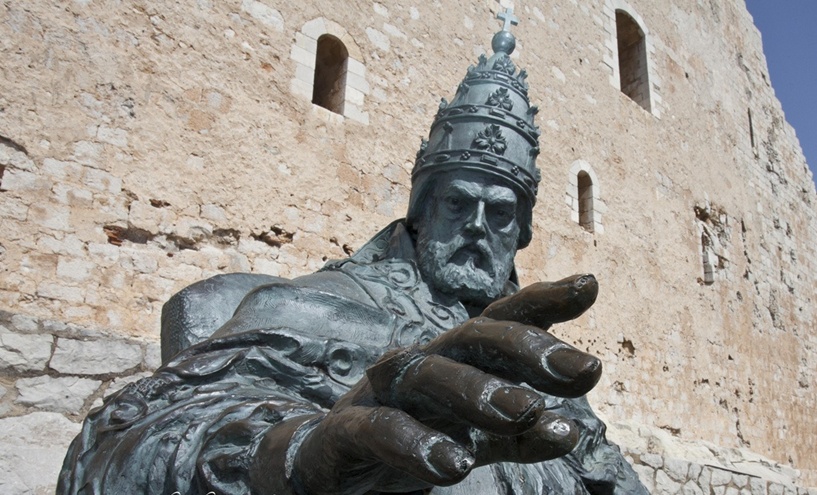
Born in 1328 in Ilueca, Zaragoza, into one of Aragon’s great lineages, the Luna family, Pedro Martínez de Luna y Pérez de Gotor soon directed his life towards religious pursuits, becoming a cardinal in 1375,
that is, three years before the great scandal that would dramatically shake the history of the Church, and which we would come to know as the Great Western Schism.
With the Pope’s return to Rome, the subsequent return of the Holy See, and his death, the time came to elect a new pope through a conclave. Pressure from the Romans ensured that the resulting “white smoke” from the conclave favored a pope of their choosing and liking. An election that was flawed, according to the cardinals, which led to it being declared invalid and the decision to appoint a new pope who would be established in Avignon.
The Church had two popes at the same time, thus beginning a dramatic schism that would divide the Church for about 40 years. Both sees rushed to seek support, dividing Europe according to their partisans.
Upon the death of the Pope of Avignon, Pedro de Luna was elected the new Pontiff, taking the name Benedict XIII.
And precisely in what happened from this moment, lies the origin of the expression “to stick to one’s guns” (literally, ‘to stay in one’s thirteen’).
Benedict XIII never yielded to the intense pressures he suffered, nor did he submit to anyone’s political will, considering himself the only legitimate Pope until his death.
To continue his papal work, he was forced to leave Avignon when the French monarchy lost interest in keeping the Papacy on French soil.
Thus, he sought refuge in the Crown of Aragon, where he was still considered the only legitimate pope, and arrived in Peñíscola, where the Knights Templar had built a formidable fortress a century earlier.
Due to his stubbornness, he was excommunicated, persecuted, and they tried to assassinate him, but they did not succeed. A life of resistance that reached epic proportions, from the walls of Peñíscola Castle, and after the abandonment of his closest collaborator and personal confessor, Saint Vincent Ferrer.
But he stood his ground. The reason for that proverbial resistance?
He was the only pontiff elected pope by cardinals prior to the Western Schism, and for this reason, he maintained his challenge to the popes who emerged from the “rotten branch”, or those subjected to political influences, of Rome.
He would be buried in Peñíscola in 1423, convinced of being the only legitimate pope.
The legend of the Unthronable had only just begun.
Every weekend we have guided tours to rediscover the settings, characters, and fascinating history of Templar & Papal Peñíscola.


